Personal
advice

Care instructions – futon care, cleaning & durability in overview

With these futon care instructions you learn how to care for your futon, to wash the futon cover, to turn and air-out the futon and how to extend the durability of your futon.

The laying-in – the settling-in phase of a new futon

A futon consists of fine natural fibers that are delicate and malleable. If creases or bulges have formed due to transport or storage, they can usually be smoothed out by evenly pressing them flat with the palm of your hand.

It is normal for a new futon not to match its nominal dimensions exactly at first. Initially, it may be 1 to 2 cm shorter or narrower, as well as slightly thicker. This is due to the fibers having loosened during manufacturing and transport; over time, they settle, and the futon reaches its final shape.

Depressions or slight indentations may form during the initial lay-in period. These are normal and vary in degree depending on the futon type, body weight, and the surface underneath. They generally even out over time and do not usually affect sleeping comfort.

The duration of the settling-in phase depends primarily on the ratio between the size of the futon and the user's body weight. A small futon used by a heavy person may reach its final shape after just a few weeks. With a large futon and a lighter person, this process can take one to two years. After that, the futon changes only slowly, becoming merely slightly flatter over the years.

Regular turning and rotating helps the futon maintain an even shape. During the initial lay-in period, a schedule of roughly every 2–3 weeks is recommended. Once the futon has reached its final shape, turning it about every three months is sufficient.

This settling-in phase is a completely normal part of futon care and affects almost every natural-fiber futon—whether it is made of cotton, coconut fiber, or latex.
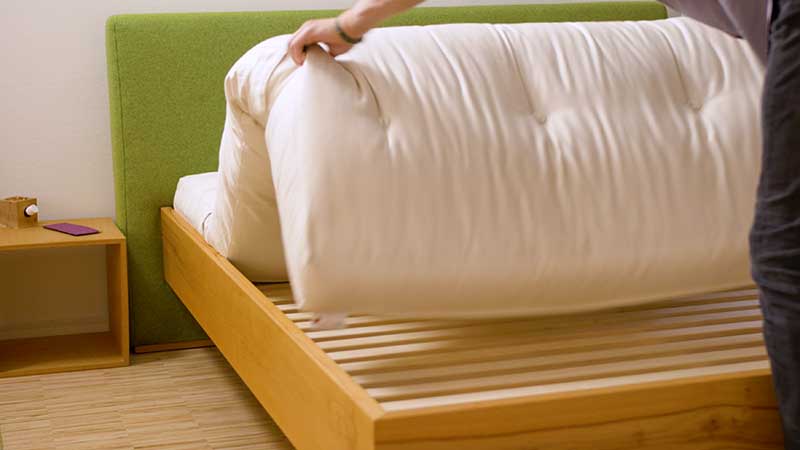
Futon lay-in phase (FAQ, german)  –  YouTube 1:30 min
Caring for the cover: Washing and properly maintaining the futon cover

The washable protective cover is deliberately cut slightly generously, as the fabric—especially in larger sizes—can shrink slightly after washing. Satin fabric however, both elastic and shape-retaining, always returns to its proper fit.

The protective cover can be washed at 60°C. Avoid using a tumble dryer if possible; if necessary, dry only briefly (for about 10 minutes). Then, put the cover back on while it is still slightly damp and allow it to air-dry completely.

A delicate wash cycle at 30 to 40°C is particularly gentle and helps preserve the fabric's suppleness over the long term.

Stains on the futon cover can generally be removed using a damp cloth and curd soap or gall soap. The treated areas should subsequently be thoroughly dried with a hair dryer.

The original buttoned cover is not designed to be removed. Removing it can lead to problems and should therefore be avoided.

Proper care of the futon cover—from gentle washing to stain removal—is an important part of futon maintenance and ensures a long-lasting, well-kept futon.

Buttons and handles for futons: spare parts and accessories

If a button tears and slips inside the cover due to heavy use or frequent transport, the futon's functionality is not impaired. Buttons and their thread primarily serve to maintain tension and facilitate transport; once the futon is in regular use, they are largely irrelevant to its function.

Individual buttons or their thread can be reordered free of charge if needed. Additionally, to re-insert them, a threading needle can be borrowed against a deposit.

For futons equipped with turning handles, the futon's substantial weight should be taken into account, particularly for sizes of 160 cm × 200 cm and larger. The handles are securely stitched and intended solely for lifting and turning; however, pulling hard on the handles or carrying the futon by them should be avoided.

Replacement buttons, thread, and reversible handles are practical futon accessories that make turning and transporting the futon easier.

Properly turning and airing out the futon

In general, every mattress benefits from being turned regularly. Even usage relieves stress on the material, aids ventilation, and contributes to a longer lifespan.

Depending on usage, it is recommended to turn the futon when changing the bed linen or approximately once or twice a quarter. To ensure even wear, you should alternate between turning it along the longitudinal and transverse axes.

For a bed with a roll-up or frame-style slatted base, no additional ventilation is usually required for everyday use, provided the futon is left uncovered and the duvet is folded back during the day. This allows any absorbed moisture to escape.

Futons placed directly on the floor require a bit more attention. Temperature differences between the top and bottom can lead to condensation, which is less able to escape on smooth, non-breathable flooring.

If the futon is placed on a rug—especially one made of natural fibers—the situation is usually unproblematic. The rug acts much like an additional breathable layer. Nevertheless, turning the futon more frequently—about once or twice a month—helps ensure even use.

On smooth flooring such as parquet, tile, PVC, or laminate, the futon should be partially folded over at regular intervals during the day to allow the underside to dry; you can alternate between folding over the head end and the foot end. Proper room ventilation is particularly important during the winter months, in ground-floor or basement rooms, and against cold exterior walls. In warm, dry rooms or on upper floors, this is generally less critical.

Airing out a futon in the sun during the summer can further aid in its revitalization. Fresh air helps support this process of refreshing and regeneration. At the same time, the natural hygienic properties of the virgin wool are restored through contact with oxygen.

In summary, airing the futon primarily serves to dissipate the condensation that forms in every bed—the extent of which varies depending on usage, the season, and the indoor climate. Regular turning, on the other hand, ensures even wear and tear, thereby extending the futon's lifespan.

Turning and airing out the futon are two key maintenance measures: regularly turning the futon distributes the load evenly, while consistently airing it out prevents moisture buildup and noticeably extends the futon's lifespan.

Ventilate the futon properly (FAQ, german)  –  YouTube 2:04 min
The ideal base for a futon: slatted frame, tatami mat, and more.

Ideally, a futon is placed on a surface that is as even as possible, such as the floor. A tatami mat can also be used, creating a clearly defined, aesthetic sleeping environment; however, it does not significantly improve the futon's ventilation.

For a standard bed, roll-up or framed slatted bases with a gap of less than 4 cm between the slats are suitable options. These supports are uncomplicated, affordable, and reliable in everyday use.

Anyone wishing to enhance the adaptability and comfort of a futon can use an elastic Ergovlex slatted base. This supports contour adaptation—particularly when sleeping on one's side—and improves pressure relief.

All our futons can be used on the aforementioned bases.

Whether placed directly on the floor, on a tatami mat, or on a roll-up slatted base, a rigid frame, or an Ergovlex slatted base—the right support enhances the futon's sleeping comfort, ventilation, and durability.

What is my futon on? (german)  –  YouTube 4:47 min
The Durability of a Futon: Extending Its Lifespan

The lifespan of a futon cannot be determined across the board, as it depends on various factors such as load, usage, indoor climate, and care.

Experience shows that a suitable futon—provided it is of high material and manufacturing quality and receives regular care and adequate ventilation—can offer good comfort for about 10 to 15 years, and often even longer.

If the mattress loses firmness over the years—particularly for side sleepers—or if the sleeping comfort no longer meets personal needs, a topper can be a sensible addition. Depending on body weight and the type of topper, this can often extend the mattress's lifespan by 3 to 10 years.

With proper futon care—regularly turning and carefully airing out the futon, and washing the appropriate cover—as well as a suitable topper, you can significantly extend the durability and lifespan of your futon.